The Great Migration to a New Era—One That's Always Been True
2026-03-18 · 4 min read
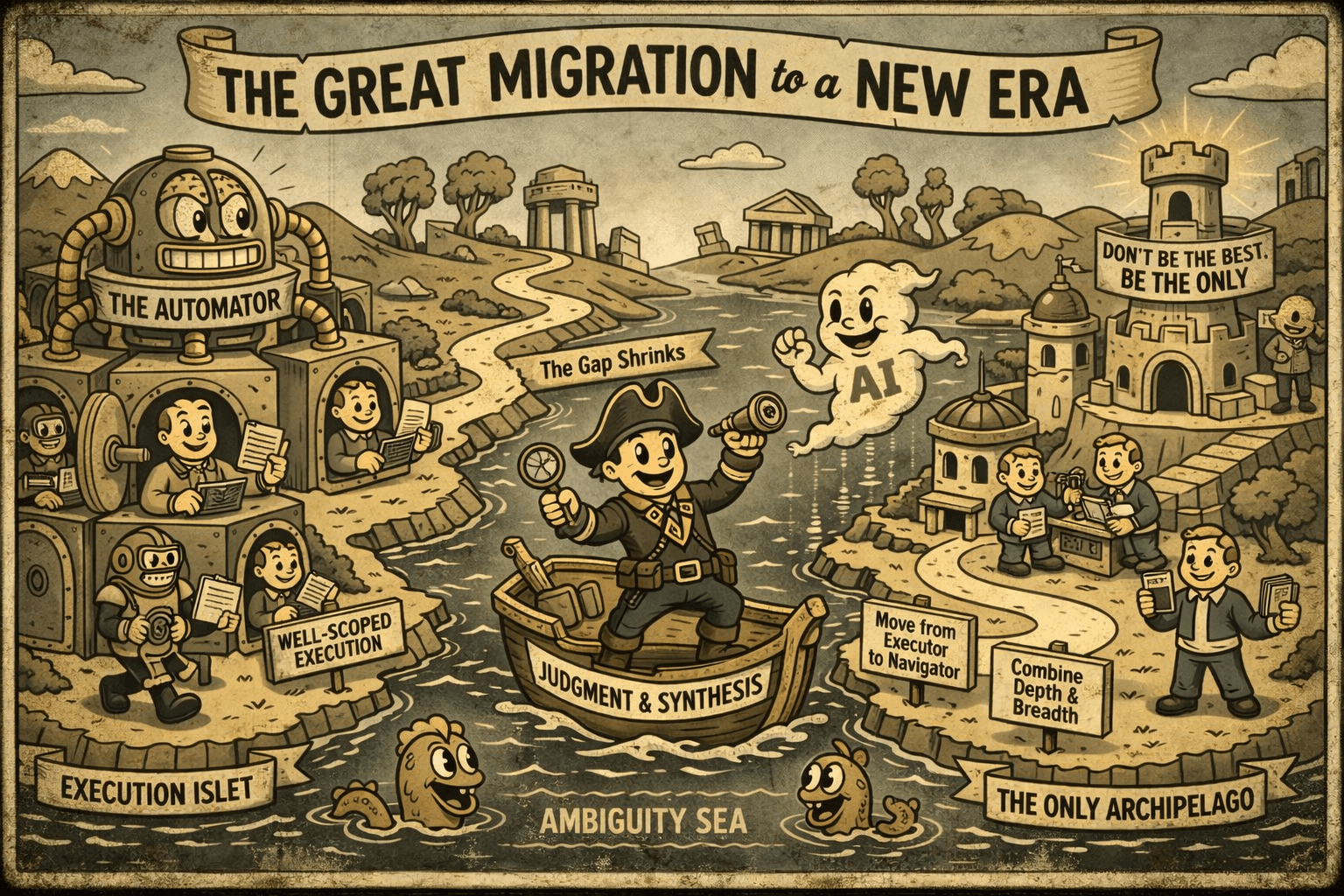
Recently, I stumbled across the idea: don't be the best, be the only. It's a philosophy that really resonates with me, especially as AI ushers in a new era for developers and, increasingly, for knowledge workers more broadly. In conversations with peers, in group chats, and while doomscrolling on Twitter, I constantly see people claiming that AI will replace software developers, or even knowledge workers in general. I understand why people feel that way, but I'm still optimistic.
Part of that optimism comes from the fact that I don't think AI is creating an entirely new truth. I think it's making an old one harder to ignore. The people who become especially valuable are rarely just the ones who are the best at one isolated task. More often, they are the ones who combine depth, judgment, taste, and context in a way that makes them uniquely effective.
The Real Migration
To me, that's the real migration happening right now. It's not a migration away from expertise, and it's not a migration toward shallow generalism. It's a migration away from being valued primarily for executing clearly defined tasks, and toward being valued for connecting domains, owning outcomes, and operating well in ambiguity.
That doesn't mean expertise stops mattering. Deep specialists will still be mission-critical, and there will always be work that demands real mastery. But for most people, the better path is not breadth instead of depth. It's enough depth to be credible, combined with enough breadth to contribute across adjacent domains and enough judgment to know how those pieces fit together.
AI Reshapes the Equation
This is where AI changes the shape of the equation. Traditionally, breadth often meant having shallow familiarity across a lot of areas, while depth meant going very far in one. In the AI era, breadth can increasingly mean real working competence across several adjacent areas. AI can help people get to useful competence much faster than before. That is not the same thing as expertise. Expert-level judgment is still hard-earned, contextual, and difficult to achieve. But it does mean the gap between "I know nothing about this" and "I can meaningfully contribute here" is getting smaller.
A rough way to think about it is that a relatively small amount of focused practice can already make someone surprisingly capable in many fields. AI seems to compress that process even further—not because it magically turns people into experts, but because it lowers the cost of learning, experimenting, getting feedback, and building momentum in adjacent domains. The result is that more people can develop multiple areas of real capability, not just surface-level awareness.
Where Value Actually Accrues
Coming from startups for most of my career, along with consulting and contracting work on the side, that has become increasingly clear to me. The people who create disproportionate value are usually not the ones who stay boxed into a single lane. They are the ones who can move between building, communicating, prioritizing, analyzing, and shipping. More importantly, they are often the ones who can navigate vague problem spaces—situations where the goal is unclear, the constraints are changing, and the path forward isn't already written down.
A lot of the highest-value work looks like this. It starts with a messy business need, a half-formed product idea, an operational bottleneck, or a user problem that nobody has framed well yet. The people who stand out are the ones who can bring structure to that ambiguity: define the problem, ask the right questions, pull in the right context, and turn uncertainty into momentum.
The Premium Shifts
For an engineer, that might mean moving between code, product sense, communication, and business context. For another knowledge worker, it might mean some other mix of writing, strategy, operations, research, and execution. The exact combination changes, but the pattern stays the same. Value accrues to people who can pair real capability with the ability to navigate ambiguity and drive outcomes across functions.
That's why I think AI amplifies this dynamic rather than replacing it. As the execution of well-scoped tasks becomes cheaper and more accessible, the premium shifts even further toward judgment, synthesis, prioritization, and ownership. AI can generate options and accelerate delivery, but it still works best when someone can define the problem, choose the tradeoffs, and decide what actually matters. The people who thrive won't just be the ones who can do one task better than everyone else. They'll be the ones who can combine multiple capabilities into something that is hard to replicate.